- QDNL Participations
- Posts
- A major milestone: €25m raised of our €60m quantum startups fund
A major milestone: €25m raised of our €60m quantum startups fund
Here's what's next...

Ton van 't Noordende
February 05, 2025
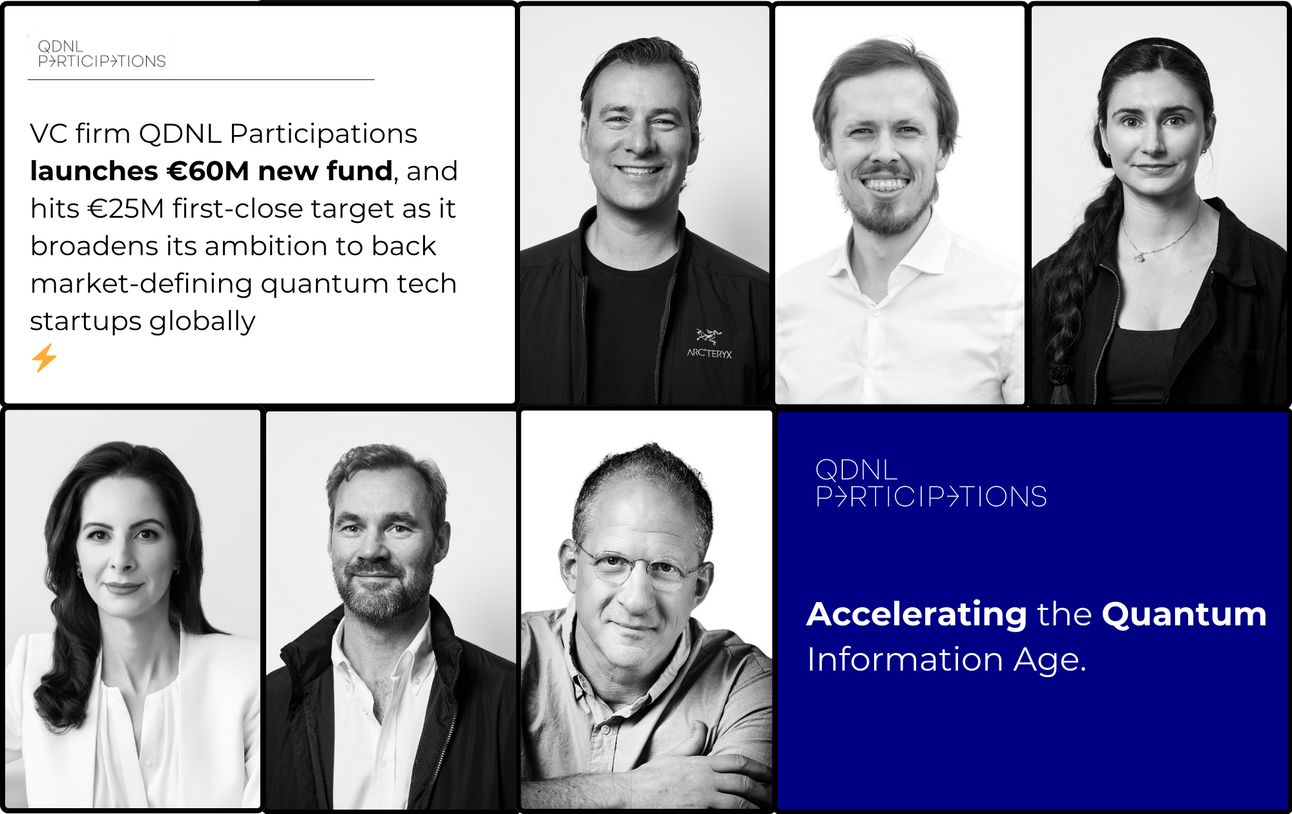
As you might have seen in the tech news recently, we have hit a significant milestone in the QDNL Participations mission to back quantum tech startups around the world.
We’ve raised €25 million of our €60 million quantum startups fund.
This includes contributions from investors including family offices, high-net-worth individuals, funds-of-funds and endowments, along with the continued support from the Quantum Delta NL Foundation.
Where we’re going…and why
Our goal is to become the definitive investor in quantum technologies globally, at a time when fields like quantum computing, sensing, and communication are increasingly expanding beyond the lab and into early commercialisation.
But why a specialist quantum fund with a global remit?
There is a serious lack of specialist investors in the quantum space. If you don’t understand the technology and its actual potential beyond the hype, you cannot make informed investment decisions.
This is holding back development of quantum technologies around the world. We want to change that, with a team that lives and breathes quantum and understands the need to grow an ecosystem of companies serving the whole quantum tech supply chain.
Now is the optimal window for early stage quantum investments, with technology and markets maturing alongside significant non-dilutive capital tailwinds, to create ideal conditions for new and early stage ventures.
With a team that spans Europe and North America, along with our worldwide network of connections, we’re well placed to identify and support the best quantum tech opportunities wherever they emerge.
We’re going to build the next wave of global leaders in quantum technology, and become the best performing quantum-specific venture firm.
– Ton
Portfolio news
Updates from companies we’ve backed so far:
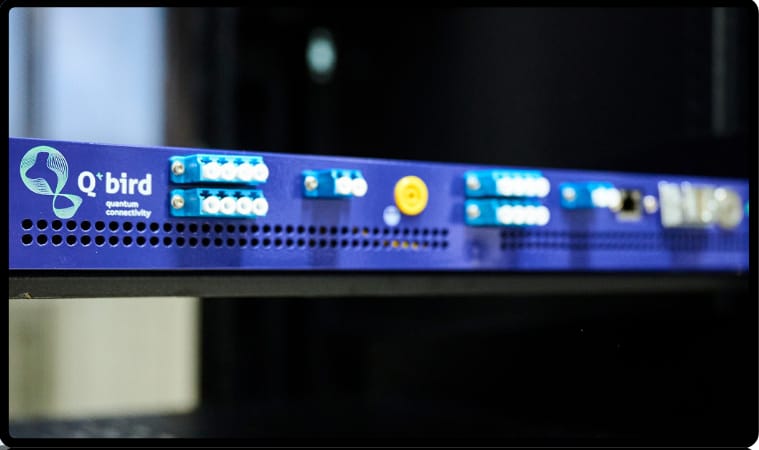
Q*Bird’s Quantum Switch
Q*Bird has made a significant step forward in quantum networking, with the creation of technology to allow multiple users to set up a quantum link simultaneously. The new Quantum Switch product is now commercially available, following successful deployment with SURF in the Netherlands.
QuantrolOx and Qblox have set a new industry benchmark using Quantware’s QPU, achieving fully-automated QPU characterization and tune-up of a 2-qubit gate in under 25 minutes. This task, previously requiring several PhD-level experts working for up to a week, marks a significant leap toward scalable quantum computing.
Fermioniq released a new research paper describing a novel method for significantly improving the accuracy of emulations of noisy quantum computers. The new method is powered by Fermioniq’s quantum circuit emulator Ava, which last year became the first third-party tensor network emulator on NVIDIA’s CUDA-Q platform.
QT Sense has onboarded Hoang Nguyen as COO. Hoang has spent almost a decade managing corporate relations, career services and investment at the University of Groningen, before co-founding Protyon, building software solutions for clinicians to provide optimal personalised treatment and enhance the quality of life of lung cancer patients.
CUbIQ Technologies has been accepted into the Defence Innovation Accelerator for the North Atlantic (DIANA), an organisation established by NATO to find and accelerate dual-use innovation capacity across the Alliance.
Look out for more notable news from our existing portfolio in the coming weeks, alongside new deal announcements.
Quantum momentum
The latest news you should know about from the quantum sector:
Superconducting quantum computing company Alice and Bob from France has raised a €100 million Series B round, the first of what is likely to be a few large raises for quantum computing companies this year.
Thales Alenia Space and Hispasat have begun development of the world’s first quantum key distribution (QKD) system capacity from geostationary orbit, with a budget of €103.5 million. The consortium also includes several Spanish universities, including the University of Vigo, which has recently significantly expanded its quantum cryptography research capabilities.
The State of Maryland and the University of Maryland have announced a $1 billion ‘Capital of Quantum’ initiative with IonQ, focusing on quantum computing and networking.
Quantinuum has signed a partnership with SoftBank, to jointly develop a comprehensive plan for practical quantum computing, including use case identification, infrastructure design, business model exploration.
IonQ has announced a new $21.1 million project with the United States Air Force Research Lab (AFRL) to develop quantum networking technologies, focusing on establishing free-space optical links from ground stations to drones. The networking aspect builds from IonQ's recent acquisitions of quantum networking companies, such as Entangled Networks and more recently Qubitekk.
In what could be one of the first practical demonstrations of quantum usefulness, researchers at the University of Toronto have used a combination of quantum computing and generative AI with classical computing methods to design molecules targeting a cancer-driving protein called KRAS, which had previously been considered “undruggable.”
Donald Trump has nominated Darío Gil, senior vice president at IBM Research, to become the Department of Energy’s undersecretary for science and innovation. Gil previously oversaw quantum computing research at IBM, leading to breakthroughs in the field.
NVIDIA will host its first Quantum Day at its GTC 2025 event in March. CEO Jensen Huang will discuss the future of quantum computing alongside major companies in the field. This positive move counters Huang’s recent comments about long timelines in the field. Optimism about the timelines for quantum have also recently been expressed by Bill Gates.