- QDNL Participations
- Posts
- Why 2026 will be a huge year for quantum
Why 2026 will be a huge year for quantum
And why 2025 was the turning point

Ton van 't Noordende
January 06, 2026
2025, the International Year of Quantum Science and Technology, did not disappoint. It was an incredible year of growth for quantum tech, and the launch of our fund at QDNL Participations could not have come at a better time.
I thought it would be useful to start the new year by sharing where we stand as a fund, and the state of the quantum technology market.
Long story short, 2026 is shaping up to be an incredibly important year for quantum, and at QDNL Participations we’re well placed to make the most of it.
Our deep expertise and network in the quantum and investment space means we will continue to be able to pick the winners and help them succeed, wherever they’re based. In particular, we are working on some exciting new initiatives in the US, which we will be implementing soon.
Read on for a full round-up and a look forward. Roll on 2026. We’re ready.
– Ton
2025: Our year in quantum
We began the year by announcing the €25 million first close of our fund for early-stage quantum startups across the world.
Since then we’ve expanded our team and grown our portfolio with our first East and West Coast US deals. We welcomed SiC Systems, EuQlid, and Quantum Elements to our portfolio, and we have more startups ready to be announced in the new year.
We have also become more present in the public sphere. We have shared our views on the quantum industry at multiple panels and conferences. We have also organized a number of exclusive investor events, offering behind-the-scenes looks into the future of quantum technologies.
Portfolio growth:
Our existing portfolio is developing extremely well, and some of our original nine investments have firmly entered the growth stage, while others have been making major technical breakthroughs, which will fuel their growth.
2025 saw impressive follow-on rounds for Quantware ($27 million Series A) and Orange QS (€12 million Seed). And you can expect 2026 to start with some exciting announcements as well.
What does 2026 hold for QDNL Participations?
We’re really excited about next year here at QDNL Participations:
We expect to close up to 10 new investments in 2026.
We expect some incredibly impressive funding rounds from companies in our portfolio.
Following our first US investments in 2025, we’ll be further expanding operations across the Atlantic.
Expect further news about our fund as the year goes on, including final close.
The quantum market: where next?
Why was 2025 a breakthrough year for quantum? Let’s take a look.
Market snapshot

While quantum investment slowed down in 2022 and 2023 following the general market correction of 2021, the industry started accelerating again in 2024.
Investment then exploded in 2025, more than doubling year over year.
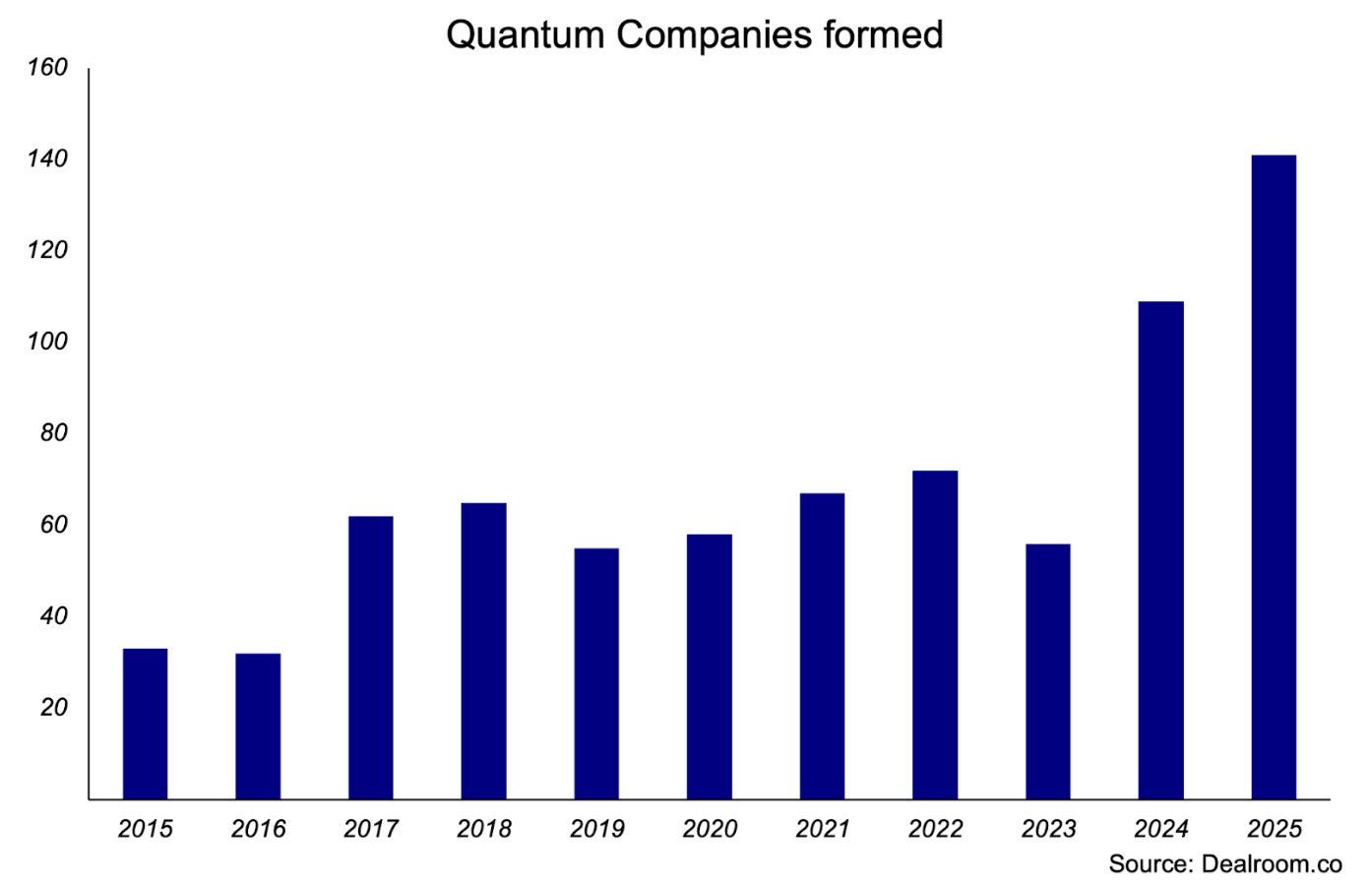
While driven largely by a number of significant raises from the first wave of quantum computing companies, we have also seen a large number of new companies being formed and funded, often selling into the bigger players.
What’s more, we have seen institutional investors entering the mix, with deals involving the likes of BlackRock, Fidelity International, and T. Rowe Price Associates.
What’s attracting them is the decacorn valuations that are coming into the field. For example, Quantinuum’s valuation grew to $10 billion in its recent $800 million raise.
Major M&A events have also started to take place. Take Oxford Ionics’ $1.1 billion acquisition by IonQ, for example.
Overall, it is clear the market is maturing.
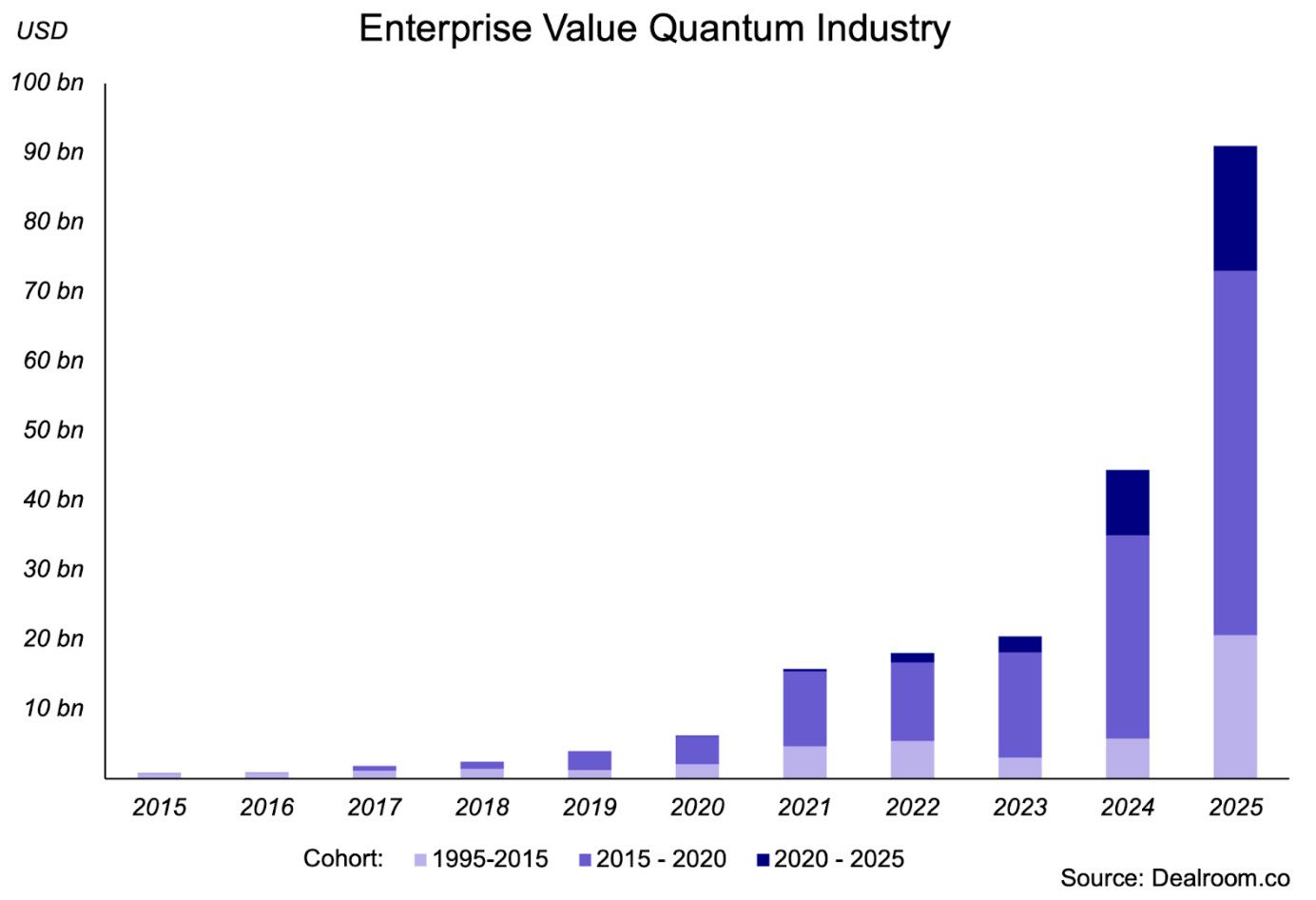
Enterprise value in quantum has grown sharply since 2020, with acceleration from 2023 to 2025, signaling a step change in market expectations.
Value creation is increasingly driven by first-generation quantum companies (2015–2020), reflecting time-in-market and compounding capital and valuation effects.
The growing enterprise value attributed to 2020–2025 companies indicates that the quantum sector still offers room for new entrants to create significant value.
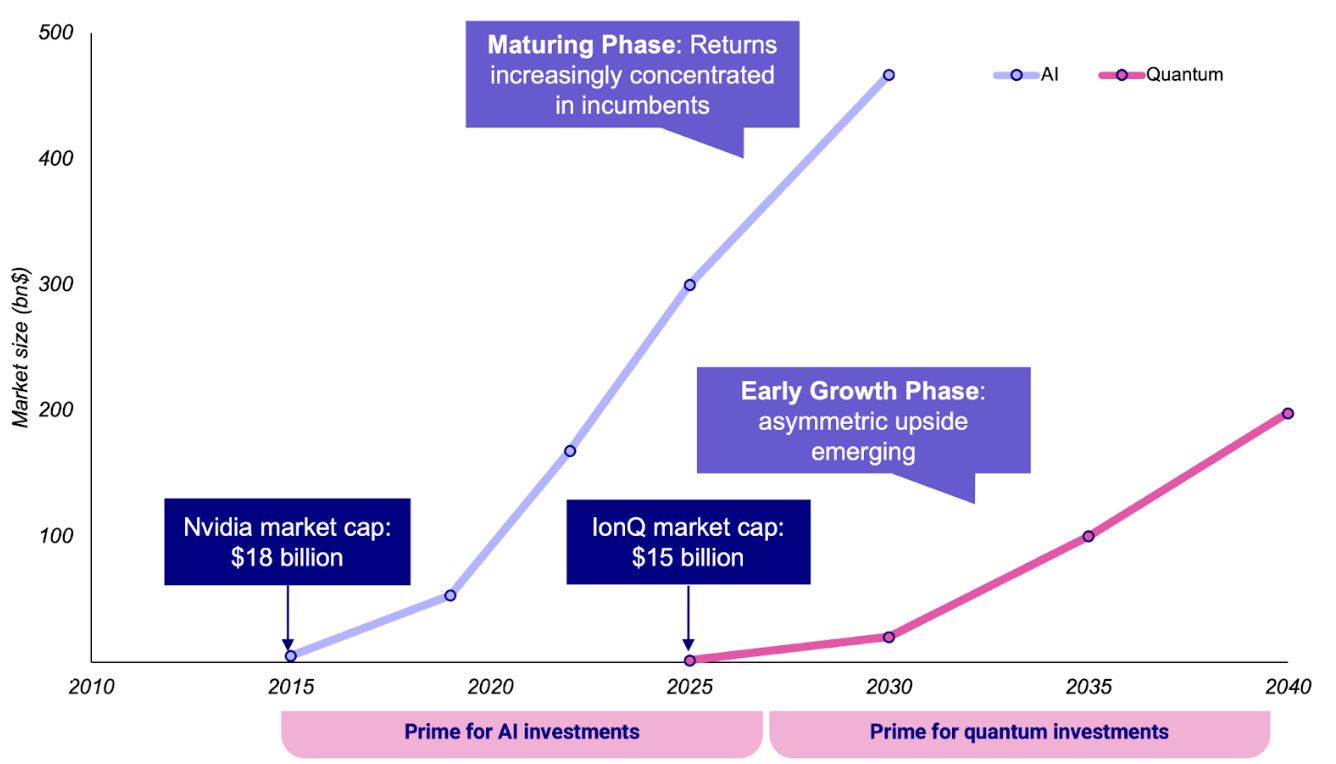
In contrast to AI, where value creation has consolidated around large incumbents, quantum remains at an early stage of market formation.
The sector is scaling from a low base, with value creation still ahead rather than behind.
Asymmetric returns are therefore more likely to emerge from quantum as a frontier technology than from increasingly mature AI markets.
2025 market highlights
Investment:
It was a big year for investment in quantum, signaling confidence in the future of the field. Here are some of the biggest deals of the year:
IonQ raised $1 billion from Heights Capital Management. Morgan Stanley also disclosed a 7% ownership stake in the company.
PsiQuantum raised $1 billion to build million-qubit scale, fault-tolerant quantum computers. Investors in the round included NVIDIA’s venture arm, NVentures. PsiQuantum will collaborate with NVIDIA in areas including quantum algorithms and software, GPU-QPU integration and PsiQuantum’s silicon photonics platform.
Quantinuum’s latest round was oversubscribed at $800 million, with a $10 billion valuation, after Fidelity International made its first investment in the company. NVIDIA’s NVentures also participated.
QCi raised $750 million through an oversubscribed private placement led by the company’s largest shareholders. The funds will be used to accelerate commercialization and drive expansion.
Infleqtion, which is commercializing atom-based quantum systems across computing, sensing, and precision timing, raised a $100 million Series C round and announced its intention to go public via a SPAC.
IQM raised a €275 million Series B round, giving it a unicorn valuation.
Boston-based QuEra, which is focused on using neutral atoms to push quantum computing forward, raised a $230 million convertible note from the likes of Google and SoftBank. The round was then further extended as NVIDIA’s NVentures backed the company.
Multiverse Computing demonstrated the potential of quantum-inspired computing with a €189 million Series B led by Bullhound Capital, to ramp up commercialisation of its AI compression tech.
M&A:
Notable exits this year:
Google Quantum AI acquired Atlantic Quantum, an MIT spinout developing superconducting quantum hardware, to accelerate its work on developing error-corrected quantum computers.
IonQ announced the $1.1 billion acquisition of Oxford Ionics, a leading developer of ion trap quantum computers. It also announced the acquisition of Lightsynq, Capella Space, Qubitekk, and ID Quantique this year, as well as the intention to acquire Vector Atomic, a quantum sensing company specializing in the positioning, navigation, and timing (PNT) space.
Xanadu will list on the Nasdaq via a $3.6 billion SPAC deal with Crane Harbor Acquisition Corp.
Horizon Quantum is to go public via a SPAC deal, merging with NYSE-traded dMY Squared Technology Group. The deal values Horizon at around $500 million.
Global competition:
This year has seen governments around the world double down on quantum, increasing spending in this space as they compete to attract and retain the best talent and achieve strong sovereign capabilities.
For example:
In the USA, states are competing with each other to build strong quantum offerings across business and academia. Also, the Pentagon has named quantum technology as a central priority for the future of the US military.
The EU has published its Quantum Europe Strategy, with the aim of positioning the bloc as a global leader in quantum by 2030. It is also in talks with potential anchor investors for a €5 billion tech fund that will back companies working on strategic technologies such as quantum computing.
Quantinuum and Al Rabban Capital have launched a joint venture that will see up to $1 billion invested over 10 years by Qatar in quantum technologies and workforce development.
The UK has announced it is allocating a further £1 billion towards quantum over the next four years, as part of its £40 billion R&D budget.
Japan is to invest $900 million to boost quantum research in the country. It plans to launch a 600-kilometer quantum-encrypted fiber network linking Tokyo, Nagoya, Osaka, and Kobe by March 2027.
Spain has launched a €800 million quantum strategy as it looks to position itself as a leader in quantum technologies, while protecting its digital infrastructure.
More notable developments:
Google recently claimed its Willow processor has achieved quantum advantage over a classical supercomputer on a real application, building upon its quantum supremacy results from last year.
Quantinuum and JPMorgan revealed one of the first demonstrations of quantum advantage on a real use case.
IBM revealed two new quantum computers, Loon and Nighthawk, based on a networkable architecture, paving the way for large-scale, fault-tolerant quantum computing. With Cisco, IBM has announced a plan to lay the groundwork for networked distributed quantum computing. It has set a target to demonstrate a proof-of-concept by the early 2030s.
Thales Alenia Space and Hispasat have begun development of the world’s first quantum key distribution (QKD) system capacity from geostationary orbit, with a budget of €103.5 million. The consortium also includes several Spanish universities, including the University of Vigo, which has recently significantly expanded its quantum cryptography research capabilities.
Microsoft caused a real stir with the announcement of its Majorana 1 chip, the first based on topologically protected Majorana qubits. It offers a potentially highly efficient path to scaling quantum computing, which has spurred intense debate from the academic community.
Bosch has partnered with synthetic diamond provider Element Six to create a new company called Bosch Quantum Sensing, which will explore market opportunities for quantum sensors.
What does 2026 hold for the quantum industry?
Quantum shifts into a broader spotlight
The key theme for quantum technology in 2026 will be its shift from theoretical to practical advantage, with quantum sensing, communications, and even computing starting to solve real problems.
This also means quantum will evolve from a relatively obscure field of deep tech to something everyone needs to be aware of, as happened with AI.
Growing investor opportunities in quantum
Looking at the rapid rise in quantum computing stock prices in 2025, it is clear retail investors are seeking exposure to this final frontier of technology.
With a number of SPAC deals already planned for 2026, we expect the number of quantum stocks on public markets to meaningfully increase this coming year.
Between IonQ’s acquisitions and companies like InfleQtion entering the stock market, this will also be the first year public investors gain exposure to quantum sensing and communications.
Increased M&A activity
One notable theme in 2025 was IonQ’s run of acquisitions.
With more companies tapping the public markets for capital and an increasing number of large rounds in the space, we can expect to see newly capitalized giants bolstering their scale or expanding their capabilities with acquisitions.
The quantum industry as a whole will benefit from these companies’ access to public market liquidity.
Quantum security becomes critical
Quantum-safe cryptography, which includes both post-quantum cryptography (PQC) and quantum key distribution (QKD), is set to become a board-level topic at businesses around the world, driven by advances in quantum computing and increasing security concerns at a global level.
While many once believed quantum computers capable of breaking existing encryption were still many years away, timelines have compressed. It really is time to prepare.
The real challenge is baking this protection into all of our infrastructure, from smart devices to public utilities. It will require level-headed, serious commitment from policymakers, CEOs, CTOs, CISOs, and beyond to achieve the comprehensive security that we’ll need when “Q-day” arrives.
Get in touch with QDNL Participations: drop me a line.
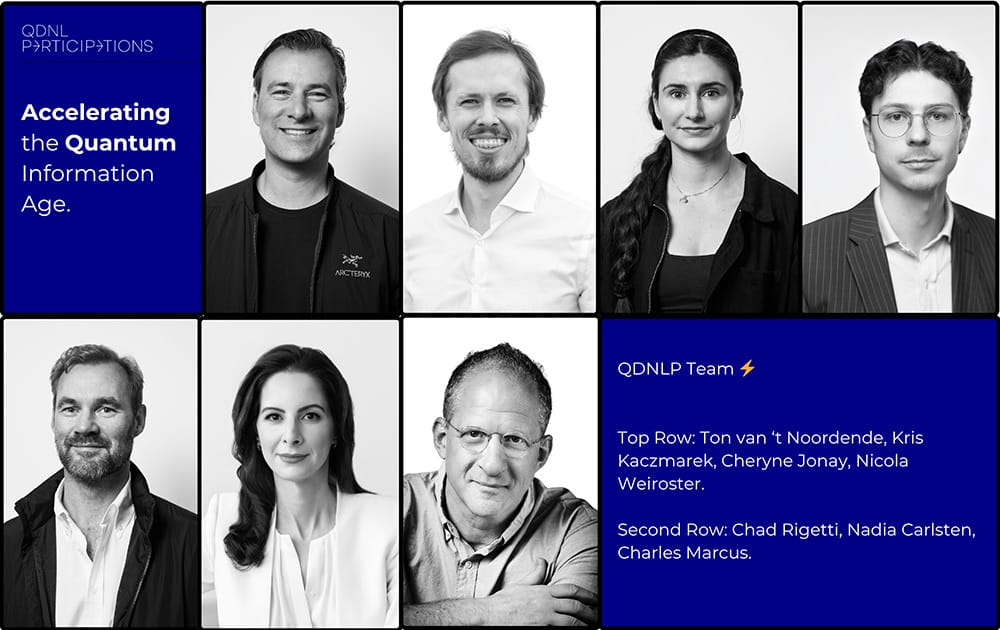
Look out for more news from QDNL Participations soon.